How Projection Surfaces Changed from Fabric to Portable Screens
Learn how projection surfaces changed from fabric to portable screens, and use that history to choose a material and format that suits your room.
Projection surfaces changed from painted fabric to portable screens as people sought more control over where an image appeared and how its surface behaved. That change was not a simple march toward better pictures: each material offered a different balance of image consistency, setup, and room use.
Why did fabric become a projection surface?
Before projection screens became familiar room fixtures, a projector needed a surface large enough to receive an image. In rooms without a purpose-built screen, a light-colored wall or a hanging length of cloth could serve. Cloth had an obvious practical appeal: it could be brought into a room, hung for an event, and removed afterward.
Its limitations came from the same flexibility. Fabric could wrinkle, sag, or move, and its weave might show through an image. Painted or otherwise prepared cloth could provide a more uniform field than untreated fabric, but the result still depended on how evenly the material was made and hung.
That made fabric particularly suited to temporary settings, such as a hall arranged for a presentation or performance. The image did not need a permanent place in the room. The surface could appear for the event and disappear when the room returned to its other uses.
What did purpose-made screens change?
Purpose-made projection screens addressed a basic weakness of improvised surfaces: their shape and finish could vary from one setup to another. A framed screen held a surface taut, while a roll-down design could be stored when projection was over. Both gave the image a defined area separate from the marks, trim, and texture of a wall.
This did not make every screen suitable for every room. A fixed screen occupied wall space even when it was idle. A retractable screen needed a clear path to lower and raise it. The useful distinction was not simply between cloth and a manufactured surface, but between a surface that stayed in place and one designed to be put away.
For a shared room, that distinction shaped how projection fitted into daily use. The screen could become a permanent part of the room, or it could be treated as equipment brought out for a particular purpose.
How did portable screens change where projection could happen?
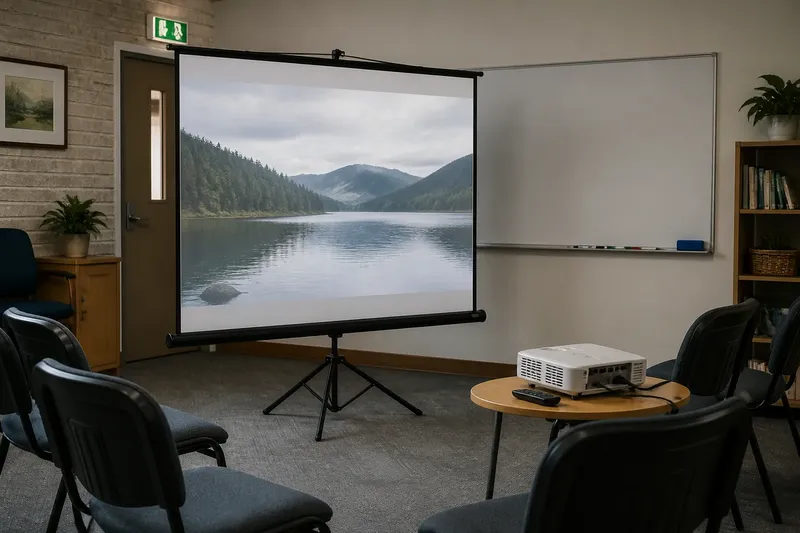
Portable screens made the viewing surface less dependent on a suitable wall. A tripod screen could be carried between rooms; a folding frame could be assembled for an event and stored afterward. The surface and its support could move to the audience rather than requiring the room to be built around a fixed screen.
Portability also introduced new demands. A stand occupies floor space, and its feet can interfere with nearby furniture or a walking route. A folding frame may need a storage place. The surface can be easy to transport yet awkward to use if the room has no clear position for it.
Imagine a community room with a whiteboard on its most useful wall and chairs set up for conversation. A caretaker brings in a portable screen for a short presentation, places it beside the board, and turns the chairs toward both. The presentation gets a dedicated surface without permanently covering the whiteboard, while the group can return the room to its previous arrangement afterward.
What do material and finish change?
The surface affects how the projected image looks. A smooth, matte finish is less likely to make texture or reflections a distraction. A fabric weave, seam, wrinkle, or rough wall finish can be noticeable, especially in broad areas of uniform color. A tinted or aged surface can also shift the appearance of whites and subtle colors.
Think of a projection surface as a pale tablecloth beneath a meal: its color and texture change the impression of what sits on top, even though the food itself has not changed. Similarly, a surface can make an image seem warmer, less even, or more textured without changing the projected source.
Material alone does not determine the result. Room lighting and the viewing angle matter too. A finish that seems unobtrusive up close may look reflective from a seat facing a nearby window or light.
How can you choose a projection surface for a shared room?
Start by deciding what the surface must do in that particular room. A fixed screen suits a space set aside for regular presentations. A retractable screen can keep a wall available for other activities. A portable screen makes sense when projection moves between locations or happens only occasionally.
- Observe the wall or proposed screen area. If it has strong color, visible texture, or reflections, then choose a smoother, more neutral surface; otherwise, consider whether the existing wall is adequate.
- Observe the seats at the sides of the room. If viewers there cannot see the proposed surface clearly, then reposition the screen or seating; otherwise, keep the current arrangement under consideration.
- Observe doors, whiteboards, shelves, and walking routes. If a fixed screen would cover or obstruct something used regularly, then consider a retractable or portable option; otherwise, a fixed location may be workable.
- Observe what happens to the room between presentations. If the room needs an open wall or flexible furniture arrangement, then favor a surface that can be stored; otherwise, a permanent screen may fit its routine.
- Observe the surface under ordinary room lighting. If reflections or uneven appearance distract from the image, then consider another finish or screen position; otherwise, judge the surface in the actual room rather than by appearance alone.
- Observe where a portable screen and its support would stand. If the stand would interfere with furniture or passage, then choose another location or a wall-mounted format; otherwise, portability may suit the room’s changing needs.
For a fully worked invented example, imagine a community room with a textured accent wall, a whiteboard used for weekly meetings, and chairs that shift between discussion and presentations. First, the caretaker observes that the wall’s texture would remain visible across the projected image. Next, they note that a fixed screen would cover the whiteboard, which the group uses between presentations. They then check a portable screen beside the board and find that the chairs can face it without blocking the doorway. Finally, they confirm that the screen can be stored when the room returns to discussion use. The resulting choice is a portable screen: it avoids the textured wall and keeps the whiteboard available, with the tradeoff that someone must set up and store the screen for each presentation.
For a product-specific decision, follow the projector and screen maker’s instructions. Surface suitability can depend on the equipment and the room.
What do people ask about projection surfaces?
Can a plain wall work as a projection surface?
It can if the wall is reasonably smooth, neutral in color, and free of distracting reflections. Judge it from the room’s actual seats, since its appearance up close may not show how texture or lighting affects the image.
Why use a screen instead of a wall?
A dedicated screen gives the image a clearly defined surface that is separate from wall features. It may also be easier to store or position, though its frame or support takes up space.
Does fabric texture show in a projected image?
It can, especially if the weave is coarse, the fabric is loose, or the image has broad areas of uniform color. Tautness and finish affect how noticeable that texture becomes.
Is a portable screen always the flexible choice?
It can be moved, but its support and storage needs may complicate a shared room. Its flexibility is useful only if the room can accommodate setup and storage without disrupting its other routines.
What should the history of projection surfaces help you decide?
The change from hanging fabric to framed and portable screens reflects different ways of managing the image’s place in a room. Fabric was adaptable but could be uneven; framed surfaces brought more control; portable formats allowed the screen to move between locations. Each choice still asks the same practical question: how much of the room should the image claim?
When choosing a projection surface, consider both the image and the material’s ordinary life in the room. A screen that gives the image a suitable surface while leaving the room ready for its next use is often the more useful choice.